

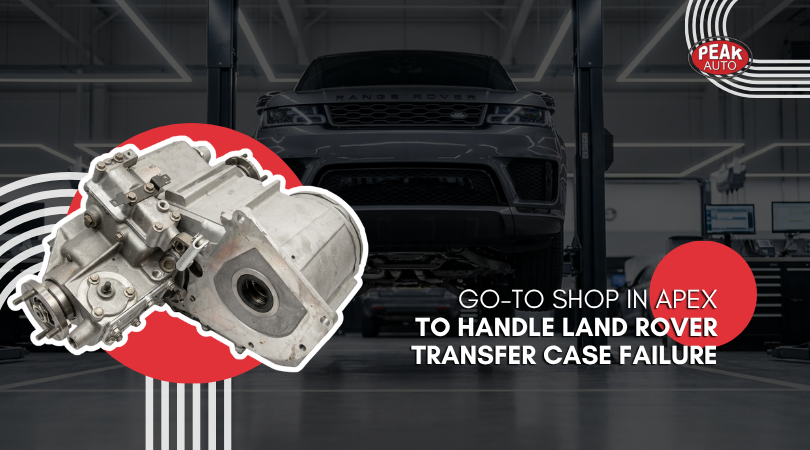
Land Rover owners in the Apex and Cary area know that their vehicles are built to handle everything from mountain trails to suburban commutes. But that capability depends on a properly functioning transfer case — the component that distributes power between the front and rear axles to enable Land Rover’s legendary off-road and all-weather capability. When the transfer case begins to fail, the vehicle’s handling changes in subtle and sometimes alarming ways. At Peak Auto in Apex, North Carolina, our European vehicle specialists have extensive experience diagnosing and repairing Land Rover transfer case failures on the full range of Discovery, Defender, Range Rover, and Freelander models.
What the Transfer Case Does
The transfer case is a gearbox located between the transmission and both front and rear driveshafts. In a Land Rover, it serves two primary functions: it distributes torque between the front and rear axles, and it provides low-range gearing for off-road use. On modern Land Rovers with permanent all-wheel drive, the transfer case operates continuously, meaning it experiences wear with every mile driven — not just during off-road excursions. A center differential inside the transfer case manages torque distribution front-to-rear, and viscous couplings or electronic clutch packs manage variation in wheel speed.
Common Causes of Land Rover Transfer Case Failure
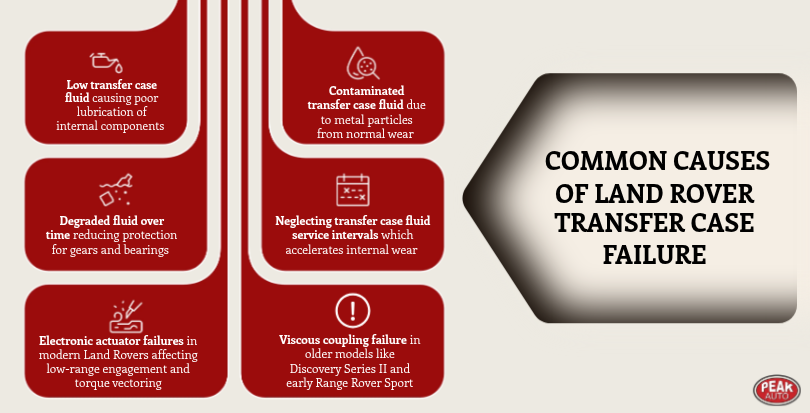
Transfer case failures in Land Rovers typically stem from one of several root causes. Low or contaminated transfer case fluid is one of the most common — the fluid lubricates the gears, bearings, and differential components, and over time it degrades or picks up metal particles from normal wear. Neglecting the transfer case fluid service interval accelerates internal wear dramatically. Electronic actuator failures are also common on modern Land Rovers, where the electronic transfer case control system manages low-range engagement and torque vectoring.
On older Land Rovers such as the Discovery Series II and early Range Rover Sport models, viscous coupling failure in the center differential is a frequent cause of handling problems and transfer case noise.
Symptoms of Transfer Case Problems
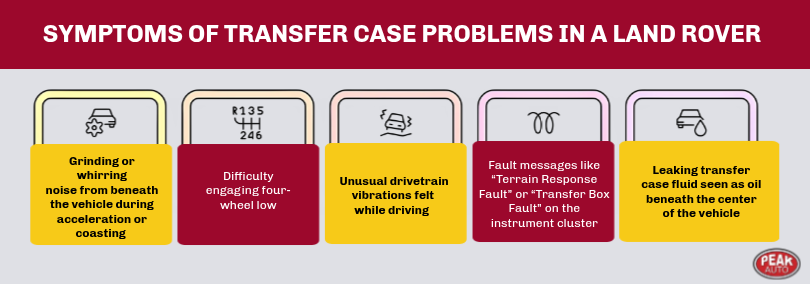
Symptoms include a grinding or whirring noise from beneath the vehicle during acceleration or coasting, difficulty engaging four-wheel low, unusual vibrations felt through the drivetrain, and for electronically controlled systems, fault messages such as “Terrain Response Fault” or “Transfer Box Fault” on the instrument cluster. Leaking transfer case fluid, visible as oil beneath the center of the vehicle, is another clear indicator.
At Peak Auto, our diagnostic process includes a fault code scan with Land Rover software, a fluid condition inspection, and a careful road test to characterize the noise or behavior before recommending any repair. Contact us online to get started.
Address: 833 US 64 Hwy W, Apex, NC 27523
Phone: (919) 363-8589
Website: peak-auto.com
Frequently Asked Questions
Q: How often should I change the transfer case fluid in my Land Rover?
A: Most Land Rover models recommend transfer case fluid service every 30,000 to 50,000 miles, though this varies by model. We recommend inspecting the fluid condition at each major service interval and changing it if there is any evidence of contamination or discoloration.
Q: Can a Land Rover transfer case be rebuilt or does it need to be replaced?
A: Depending on the extent of internal damage, a transfer case can often be rebuilt or repaired using replacement gears, bearings, and seals. In cases of severe damage, a remanufactured or replacement unit may be more cost-effective. We evaluate both options during diagnosis.
Q: My Land Rover shows a Terrain Response fault — is this related to the transfer case?
A: It may be. Terrain Response faults can be caused by transfer case actuator failures, but they can also originate from suspension sensors, ABS sensors, or the electronic control module. A thorough diagnostic scan is necessary to identify the root cause.
Q: Does Peak Auto service all Land Rover models?
A: Yes. We service the full Land Rover lineup, including the Defender, Discovery, Freelander, Range Rover, Range Rover Sport, and Range Rover Evoque.