


The car comes in with the same description most weeks. There is a hum, it gets louder with road speed, it does not change when you shift, and it has been getting worse for a couple of months. Someone at a quick service place already said “wheel bearing” and quoted a number. Maybe they are right, and often enough they are not. On an RX or an ES with 90,000 miles on a mixed diet of US-64 commuting and Apex neighborhood roads, a cupped tire makes the identical noise and costs a fraction to fix.
Noise that tracks road speed has a short suspect list
If the hum rises and falls with how fast the wheels are turning, and stays the same whether you are accelerating, coasting or in neutral at the same speed, the source is turning with the wheels. That rules out the engine, the exhaust and the transmission in one test you can do yourself on a quiet road.
What is left is tires, wheel bearings, and on all-wheel-drive models the differential and driveshaft. Most of the time it is one of the first two.
The tires come first in this diagnosis
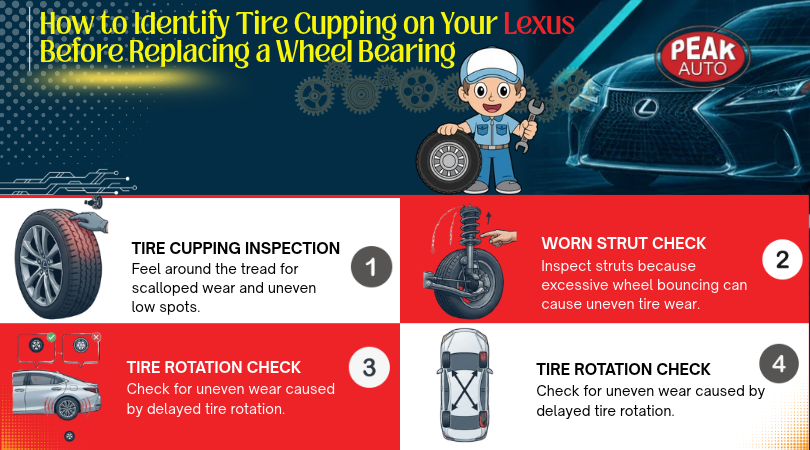
Cupping is a scalloped wear pattern that develops around the circumference of the tread. Run your hand around the tire and it feels like a series of low spots. Each one slaps the pavement in turn and the result is a drone that sounds exactly like a bearing.
Cupping does not happen for no reason. Worn struts let the wheel bounce, and the tire wears where it lands hardest. Tires that have gone too long without rotation wear unevenly for the same reason. The noise is the symptom; the shock absorber or the rotation interval is usually the cause.
A bearing sounds the same until you load it
Here is the test that separates them. On a quiet road at about 40 miles per hour, swerve gently left, then gently right. A worn bearing changes volume with the swerve, because cornering shifts the car’s weight onto one side and loads that bearing harder. Tire noise barely changes through the same swerve.
If the hum gets louder swerving right, the load has moved to the left side and the left bearing is the suspect. It is a crude test and it is right most of the time. On the lift we confirm it by spinning each wheel by hand and feeling the hub, and by checking for play at the top and the bottom of the wheel with it off the ground.
What rotation actually prevents
Rotation moves each tire to a different corner so the wear pattern does not have time to set. Skip it and the fronts wear their shoulders while the rears glaze over, and on a front-drive Lexus the fronts cup first.
A cupped tire that is caught early sometimes quiets down once the struts are replaced and the tire is rotated to the rear. Caught late, the pattern is permanent and the tire is finished no matter how much tread is left.
Why winter driving makes it louder
Cold rubber is harder rubber. The same cupped tire that droned mildly in September gets noticeably louder once overnight temperatures drop, because the tread blocks do not deform as readily and each low spot hits harder. Owners often assume something failed over the winter when the underlying wear has been building all year.
Cold also stiffens the grease in a marginal wheel bearing, which is why a bearing that was quiet on a warm afternoon can sing on the first cold drive of the week and then settle down.
What North Carolina checks and what it does not
North Carolina requires a safety inspection every year before you can renew the registration, and the NCDMV’s own list covers the foot brake, the parking brake, steering and tires. The inspection can be done no more than 90 days before your plate expires.
That catches a bald tire. It does not catch a cupped one with 7/32 of tread left, a strut that has lost half its damping, or a bearing that is rough but not loose. Those are the three things behind most of the hums we chase, and none of them is a pass-fail item.
Frequently Asked Questions
Q: How long can you drive on a bad wheel bearing?
A: A noisy bearing usually has some time left, though not unlimited time, but once there is play at the hub the wheel is no longer held square and that affects braking and steering. Get it measured rather than guessing from the noise.
Q: Will an alignment fix tire cupping?
A: Alignment stops it from coming back if the angles caused it. It will not smooth out a tire that is already scalloped, and it will not fix a worn strut.
Q: Why does my Lexus hum only above 45 mph?
A: Most tire and bearing noise needs enough rotational speed to be audible over everything else. The frequency scales with speed, so there is often a band where it lines up with the cabin’s resonance and sounds worst.
Start With the Road Test
A hum is a symptom with at least three common causes, and the cheap one is as likely as the expensive one. Bring it in and we will road test it with you if that helps, then put it on the lift.
Peak Auto, 833 US-64 W, Apex, NC 27523. More at peak-auto.com.